How to Declutter Before Moving (and Find Out What Your Stuff Is Worth)
Moving is the only time most people seriously audit their possessions. You see every cupboard, every drawer, every dusty corner of the basement. The question repeats with each item: am I taking this with me or not?
The answer comes down to three sub-questions:
- Do I want this in my new place?
- If not, can I sell it for enough to be worth the hassle?
- If not, where does it go?
This is a pragmatic guide on how to declutter before moving, focused on the part that's hardest to do well: telling junk from value at a glance.
The core problem: you don't know what your stuff is worth
If you knew exactly what each item was worth, decluttering would be easy. Sell anything over $X, donate anything under $Y, throw away the rest. The friction is that you don't know — and looking up every item by hand is the kind of task where decluttering grinds to a halt.
This is where a photo-based price check earns its keep. Costcam.app takes a photo, identifies the item, and gives you a current price range. It runs in your phone's browser, free, no signup. For decluttering it's worth using on anything you suspect might be worth selling, especially anything from these categories:
- Furniture, especially if it's solid wood, vintage, or a recognised brand
- Electronics under five years old (laptops, monitors, gaming consoles, headphones, kitchen gadgets)
- Bikes, sports equipment, camping gear
- Designer or branded clothing and shoes
- Lego sets, especially boxed
- Tools, particularly anything cordless or cast iron
- Cameras, lenses, instruments
- Dishes, glassware, and cookware from recognisable lines (Le Creuset, Vitamix, KitchenAid, certain Pyrex patterns)
- Books, only if they're first editions, signed, or art books
For most household items the answer is "donate" — but the photo check is what gives you confidence not to throw away the $300 lamp you assumed was worthless.
A 3-pile system that actually works
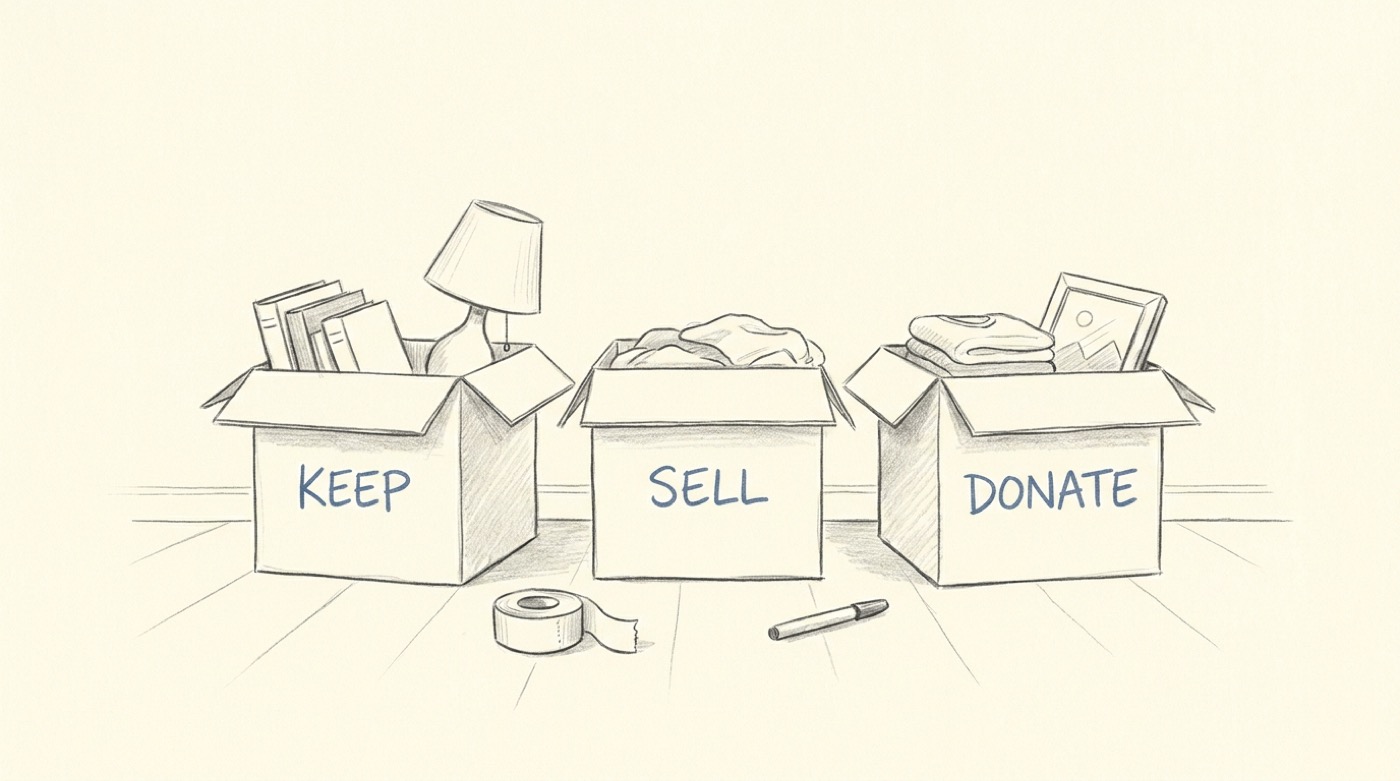
The classic Keep / Sell / Donate setup, with a clearer threshold:
KEEP — anything you've used in the last year and would replace if you lost it. Sentimental items get their own subcategory; don't argue with yourself, just keep them.
SELL — anything where the going market price is above ~$25 and you can list it without it ruining your week. Below $25, the listing-and-shipping hassle usually isn't worth it unless you're bundling.
DONATE — everything else that's still in usable condition. Goodwill, Salvation Army, local shelters, Buy Nothing groups. Get a donation receipt for tax purposes; in the US, donated items are deductible at fair market value.
Anything genuinely broken goes in the bin, not the donate pile. Donating broken stuff isn't a kindness, it's making someone else throw it out.
How much is my stuff worth — a realistic baseline
People overestimate the value of things they've owned for a long time and underestimate the value of things they think are unfashionable. Some realistic numbers:
- A used Ikea bookshelf: $20–$40, if you can be bothered to list it.
- A solid wood bookshelf from a real furniture brand: $80–$300.
- A 5-year-old laptop in working condition: 20–30% of its original price.
- A mid-tier road bike from a known brand: $200–$600 used, regardless of how dusty it is.
- A box of designer clothing in good condition: surprisingly often worth $200–$500 if listed individually on Poshmark or eBay.
- A pile of books that aren't first editions: $0.50–$2 each at best.
- Most lamps: $5–$30, unless they're vintage, mid-century, or designer, in which case $50–$500.
The pattern: brand and category matter far more than condition. A scuffed mid-century chair often beats a pristine particle-board one.
A 2-week declutter timetable
If you're moving in roughly two weeks, here's a workable plan:
Week 1, days 1–3. Go room by room. Photograph anything you're unsure about, run it through Costcam, decide pile (Keep / Sell / Donate). Don't actually move anything yet — just label it.
Week 1, days 4–6. List the Sell pile. Facebook Marketplace and Craigslist for furniture and large items (local pickup, no shipping). eBay or Poshmark for clothing, electronics, and anything portable. Group by platform, list in batches.
Week 1, day 7. Schedule donation pickup, or load the car for a Goodwill drop-off.
Week 2, days 1–4. Respond to buyers, schedule pickups, lower prices on anything that hasn't moved.
Week 2, days 5–6. Whatever didn't sell gets donated. Don't move things you couldn't sell.
Week 2, day 7. Pack what's left.
The trap to avoid is starting the listing process with no pricing strategy. People list a $5 spice rack at $40, get no offers, and conclude their stuff doesn't sell. The photo check fixes this — list at the typical price minus 10%, and most items move.
Don't move what you can't sell
The hidden cost of moving is the boxes you'll unpack in your new place and immediately wonder why you brought them. Movers charge by weight or volume; storage charges by month. If you're paying $200 to move a $50 sofa, donate the sofa.
A useful question, item by item: if this were already gone, would I buy a new one tomorrow? If the answer is no, it doesn't go in the truck.
Try the photo check
The fastest way to start is to walk through one room with your phone and Costcam open. Point the camera at anything you're unsure about and you'll have a price in ten seconds.
Open costcam.app, give it ten minutes, and you'll know more about what your stuff is worth than you've ever known before.